How Much Space Do You Need for a Pickleball Court? (from a pro player)
The official dimensions are easy to Google. What most people get wrong is the total space they actually need to play comfortably. Here's the real answer, from a pro who's played on hundreds of courts.
How much space do you need for a pickleball court? It is almost always the first question I hear from homeowners and property owners who are thinking about building. Do they have enough room? And if they do, how should they use it? The answer matters more than most people realize. Space affects not just whether you can build a court, but how comfortable the court feels to play on and what the total project will cost.
The official dimensions are easy to Google. What most people get wrong is the total space they actually need to play comfortably. That is what this post is about, from a pro player who has competed on hundreds of courts across the country.
The Official Court Dimensions
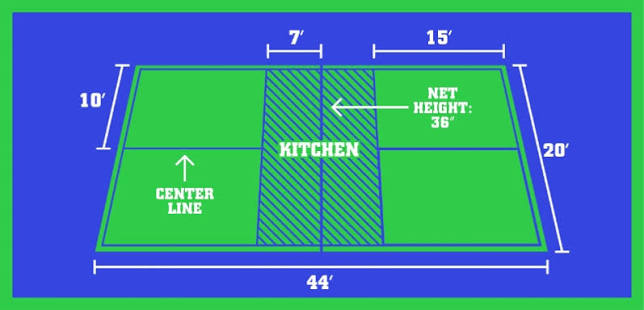
A regulation pickleball court measures 20 feet wide by 44 feet long. That footprint includes the kitchen, the service boxes on each side, and the baseline. It covers both singles and doubles play. But here is the thing: those are just the lines. Nobody plays a real game inside a painted rectangle with no room to move. The 20 by 44 measurement tells you where the ball is in or out. It says nothing about the space you actually need to play well.
How Much Total Space You Actually Need
Just like tennis, every court is built with space beyond the playing lines. You need room behind the baselines to serve and receive comfortably, and room alongside the sidelines to chase wide balls and hit around-the-post shots.
The minimum recommended total footprint is 30 feet wide by 60 feet long. That gives you 5 feet on each sideline and 8 feet behind each baseline. For most recreational backyard courts, that is the floor, not the target. When you go smaller than 30 by 60, you start to feel it immediately. You cannot stand back deep on the return of serve. You cannot move laterally to track down extreme angles. Shots that feel natural on any public park court suddenly feel cramped. I have played on courts that were built tight, and you notice it on nearly every point.
For most homeowners, I recommend targeting 30 by 60 at a minimum and going larger if the yard allows it. More run-off space always improves the experience, and you will never regret having extra room.
How a Fence Changes the Space Equation
This is something a lot of people do not think about until after the build, and it catches them off guard. A fence is great for keeping balls contained and giving the court a finished look. But it physically restricts the usable space around your playing area. Your paddle arm has a wingspan of roughly 3 to 4 feet. When you combine a fence close to the court with an already tight footprint, you end up with significantly less room to move than the raw numbers suggest.
If you are planning to add fencing, build your total footprint larger to compensate. A fence added to a minimum-size court will make the court feel noticeably smaller than it already is.
How Pickleball Compares to Other Sports
One reason pickleball has spread so quickly is that it fits. Most backyards that cannot accommodate a tennis court can handle a pickleball court without much trouble. A standard tennis court with proper run-off space runs approximately 60 feet wide by 120 feet long. That is four times the footprint of a single pickleball court. For most homeowners, that much space is either not available or simply not practical for the investment.
Pickleball fits in spaces where tennis never could, and that is a big part of why so many people are building courts at home.
How Many Pickleball Courts Fit on a Tennis Court
This comes up constantly with commercial properties, apartment complexes, and resorts that have an old tennis court sitting unused. A standard tennis court footprint of 60 by 120 feet can accommodate up to four pickleball courts depending on the layout and how much buffer space you want between them. In some configurations you can fit two side by side comfortably. With tighter spacing or a different orientation, four is achievable.
If you have an existing tennis court that is underused, this is one of the most cost-effective ways to add multiple playable pickleball courts without breaking ground on new construction. We do a lot of these conversions and the economics are usually very favorable.
Multi-Court Layouts for Commercial Properties
When you are building more than one court, the question of space becomes more complex. It is not just about how large each court should be, but how the courts relate to each other and how players move through the facility.
The most important spacing rule for side-by-side courts is maintaining at least 10 feet between net posts. Whether you achieve that with a fence divider or open space does not matter as much as hitting that number. Courts that are too close together lead to players interfering with each other, which becomes a real problem during open play or league nights.
Beyond raw spacing, good multi-court design thinks about flow. Courts grouped together in a logical cluster make it easier for players to find their court, watch other matches, take back-to-back lessons, and build the social environment that makes pickleball worth investing in. Isolated courts spread across a property tend to feel disconnected and underused.
It is also worth reserving at least one court that can be semi-private or separated from the main cluster. That court becomes valuable for programming, private lessons, tournament matches, or singles play where you want separation from the noise of open play.
Court Orientation Matters More Than People Think
Size is not the only spatial decision that affects playability. Orientation does too. For outdoor courts, north-south orientation is strongly recommended whenever the site allows it. The sun moves east to west, which means an east-west court puts the sun directly in players' eyes during the most active playing hours of the morning and late afternoon. Overheads, lobs, and any shot where you look up into the sky become genuinely difficult on a poorly oriented court.
It does not always work out perfectly depending on the shape and orientation of the yard, but if you have flexibility in where the court sits, orienting it north-south is a low-cost decision that improves every session you play on it.
Not Sure If Your Space Works? Let's Find Out Together
Every yard and every property is different. The right court size, layout, and orientation depends on your specific space and how you plan to use it.
At Backyard Pickleball Builders, I offer a free consultation where I personally review your space and give you a real recommendation based on your goals. Whether you are planning a backyard court for the family or a multi-court facility for a commercial property, reach out and let's figure out what your space can do.
Build it once. Build it right. That's our motto at Backyard Pickleball Builders.
Ready to Build Your Court?
Book a free 15-minute call with Alex and get expert insight specific to your yard and goals.
Book Free Consult