7 Essential Things to Consider When Building a Backyard Pickleball Court
Before you pour concrete, read this. Professional pickleball player Alex Neumann explains the 7 most important things to consider when building a backyard pickleball court.
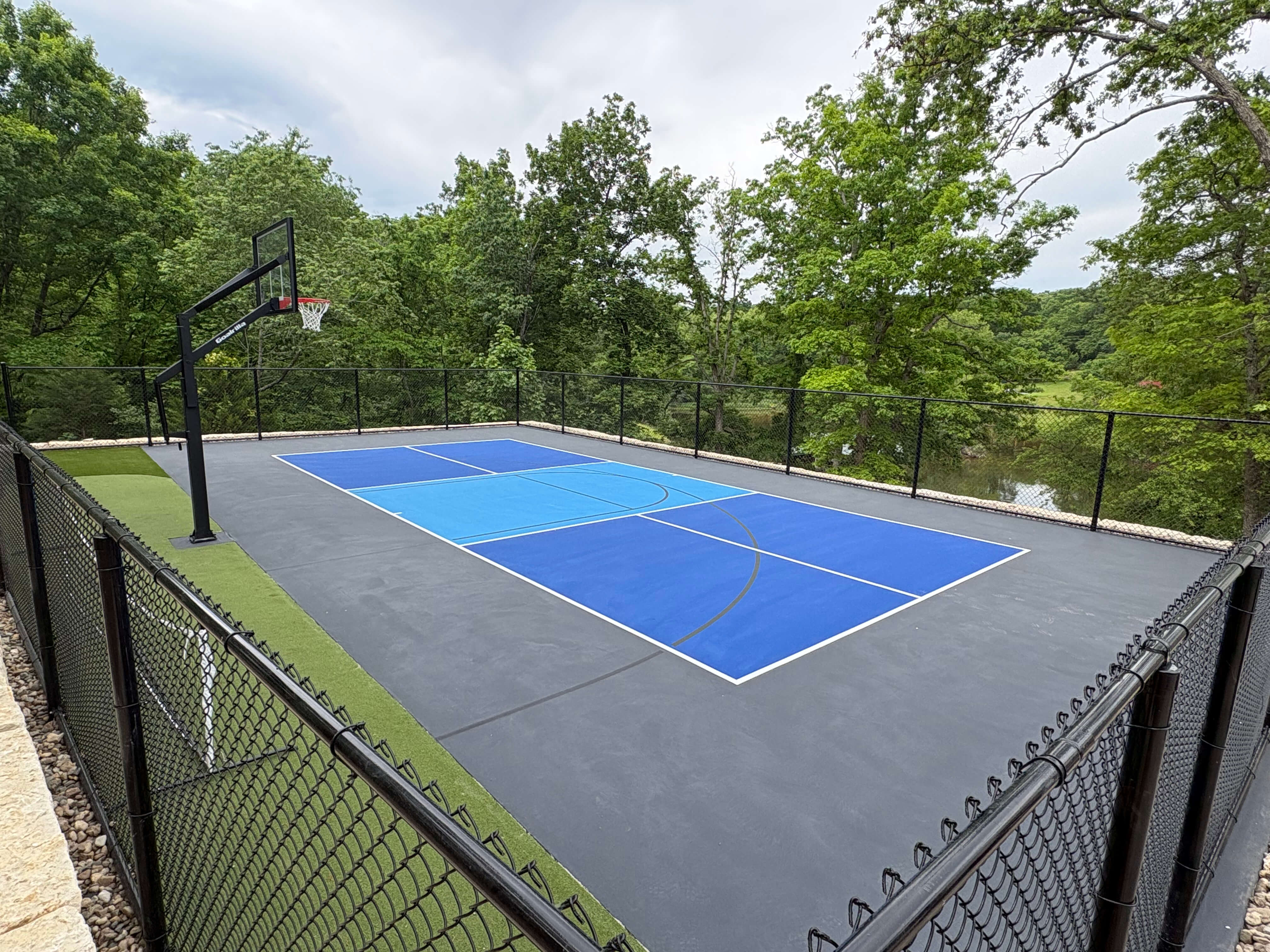
If you're thinking about building your own court at home, you're not alone. Backyard pickleball courts are exploding across the United States.
But here's what most people don't realize: there's a huge difference between a court that looks good and a court that actually plays well.
As a professional pickleball player who has competed on hundreds of courts — great ones and terrible ones — and now runs a business managing backyard court builds, here are the seven essential things to consider when building a backyard pickleball court.
1. Court Size and Layout (The Biggest Mistake People Make)
This is by far the most obvious, and most commonly done wrong, part of a build. Yes, official pickleball court dimensions are 20 feet wide by 44 feet long. But that's just the playing lines.
That is not how big your total court area should be. You can and should build larger around those lines.
The general rule: the bigger, the better.
More space allows you to:
- Move comfortably
- Hit around-the-post shots
- Chase extreme angles
- Stand deeper on serve and return
- Play aggressively in the kitchen without feeling cramped
When people build courts too small, they almost always regret it. The court ends up feeling tighter than the public park courts they're used to playing on. For backyard builds, I typically recommend a minimum of 60 feet by 30 feet. Many homeowners go larger if space allows.
Of course, you're limited by your yard, but shrinking too much is something you'll feel every single time you play.
2. Foundation: Asphalt vs. Concrete
The foundation is one of the most important decisions you'll make, and one of the biggest cost drivers.
When evaluating outdoor flooring options for your pickleball court, you're typically choosing between asphalt and concrete.
Concrete is generally more expensive than asphalt. There are also multiple types of concrete you can install depending on reinforcement and regional soil conditions.
Asphalt can be more affordable upfront but has been known to crack sooner, especially in certain climates.
The right decision depends on your region, soil conditions, budget, and long-term goals. There isn't a universal best option, there's only what makes the most sense for your location and how you plan to use the court.
3. Surface System (What Makes It Feel Like a Real Court)
Once your base is poured, the next step is surfacing.
This is one of the most important parts of the entire project in terms of how your court actually plays.
The surface layer: smooths the slab, blocks moisture, improves traction, and creates consistent ball bounce.
Most backyard courts use an acrylic resurfacer or acrylic sand-filled coating system. This is the classic sport surface. You can also choose cushioned systems that provide a slightly softer feel underfoot and reduce impact on joints.
For most homeowners, a standard acrylic system works perfectly. But if you're planning high-volume play or have joint concerns, a cushioned surface might be worth exploring. This is the layer that transforms a slab into a true pickleball court.
4. Your Net System (Permanent vs. Rollable)
This is where a lot of homeowners assume permanent is better, but that's not always true.
You can install permanent in-ground net posts (drilled into concrete) or removable or rollable backyard net systems.
I almost always recommend rollable nets for backyard builds. Here's why: they're easy to move on and off, you can use the court for basketball or other sports, you can move the net off for cleaning and maintenance, you avoid drilling into your concrete slab, and they're often more affordable.
In fact, most PPA Tour matches, the professional tournaments I compete in, are played using high-quality rollable net systems.
You're not sacrificing quality. You're gaining flexibility.
5. Fencing (And How It Affects Play)
Fencing has a much bigger impact than people realize.
It doesn't just keep balls in — it affects how large your court feels.
A fence physically restricts the space around your playing area. Your paddle can't extend through it. You can't step through it. It effectively shrinks usable space by several feet.
That's why, if you're installing fencing, I recommend making the overall court footprint larger, carefully considering fence height, and planning gate placement intentionally.
If you build too tight and then add fencing, the court can feel cramped very quickly.
Done correctly, fencing works great. Done without planning, it changes the experience in ways most people don't anticipate.
6. Lighting and Visibility
Before you even think about installing lights, think about orientation.
The sun moves east to west, which means north–south court orientation is ideal to avoid glare during peak playing hours.
That alone can dramatically improve playability.
When it comes to lighting systems, you have options: one pole with dual fixtures, two poles, or up to four poles for full coverage.
But here's my advice: You don't have to decide on lighting immediately. Lighting adds cost. And many homeowners discover they don't play at night as often as they thought.
You can build the court, play on it, evaluate shadows and usage, and add lighting later if needed.
It's better to make that decision intentionally rather than automatically adding it on day one.
7. Equipment and Playability
The final piece is equipment.
Your pickleball court equipment affects how comfortable and enjoyable your experience is.
Things to think about: What ball works best for your climate and surface? Are your paddles appropriate for your level? Do you need gear that helps reduce arm or shoulder strain?
My company partners with my paddle sponsor on tour, CRBN Pickleball, to offer free CRBN paddles and optional court sponsorship for every client we work with.
If you're building a court, it makes sense to pair it with high-quality equipment from the start.
Final Thoughts
When building a backyard pickleball court, the details matter.
The biggest mistakes I see: courts built too small, foundations chosen without regional consideration, poor orientation, overcomplicated net systems, and fencing added without expanding space.
A court should feel open, balanced, and comfortable — not restrictive.
If you're considering building your own backyard pickleball court and want expert guidance from someone who understands both construction and high-level play, reach out to our team.
Build it once. Build it right. That's our motto at Backyard Pickleball Builders.
Ready to Build Your Court?
Book a free 15-minute call with Alex and get expert insight specific to your yard and goals.
Book Free Consult