Concrete vs. Asphalt: Choosing the Right Pickleball Court Foundation
Concrete or asphalt? And if concrete, wire mesh, fiber, rebar, or post-tension? A pro player breaks down what each option is actually good at, why courts crack in the first place, and which foundation fits your climate, soil, and budget.
Foundation is, by far, the most important part of building a pickleball court. It's the biggest chunk of your total cost, and it has the biggest impact on how your court performs and holds up over time. It's also the hardest part to actually understand as a homeowner, so here's the full breakdown.
How a Pickleball Court Foundation Actually Works
A pickleball court is really three layers: the foundation, a surfacing material on top of that, and a paint layer on top of the surfacing.
The foundation itself is either asphalt or concrete, but there's much more to it than that. Below the slab sits a compacted subgrade — heavily compacted native soil that supports the weight of everything above it. On top of that is a layer of aggregate stone, usually several inches of crushed stone, which acts as the load-bearing layer. A vapor barrier sits right underneath the slab itself, blocking ground moisture from working its way up into the slab from below. Only after all of that is in place does the asphalt or concrete slab go down.
Asphalt vs. Concrete: What Each Material Actually Is
Before we get into the details, it's helpful to understand the basics of concrete and asphalt. They're made of different things, and they behave completely differently by design.
Asphalt is a mix of aggregate — crushed stone and sand — bound together with bitumen, a petroleum-based binder. That binder is what makes asphalt flexible — it can bend and give slightly under pressure rather than fighting back. Flexibility is asphalt's strength: it's more forgiving of ground movement, faster and cheaper to install, and it's been used on pickleball and tennis courts for decades. Its downside is that it's inherently softer and less structurally strong than a concrete pickleball court, and it ages over time as its binder is exposed to sun and weather.
Concrete is aggregate bound together with cement paste, which cures into a rigid, hard material. Rigidity is concrete's strength: it holds its shape and resists wear far better than asphalt over the long run, and it's the stronger material overall. Its downside is exactly that same rigidity — a rigid material doesn't bend or give, which becomes a real liability once you understand what actually causes a court to crack.
Why Courts Actually Crack
The biggest question most homeowners have when building a new court is whether it's going to crack. Every court eventually deals with cracking in some form, but understanding why helps you decide how to avoid it and which option is right for you.
Concrete's cracking comes down to its rigidity. Concrete is excellent at supporting weight pressing straight down on it — compression — but not so good at resisting stretching, bending, or twisting — tension. Think of a dried block of mud: you can stand on it all day and it won't budge, but try to bend it in half and it snaps instantly, with almost no warning.
Concrete behaves the same way. As it cures, it shrinks slightly, and as the soil beneath it settles or shifts over time, the slab gets pulled and pushed in ways plain concrete cannot resist. Left unreinforced, it can crack right along those tension lines. Reinforcement is what fixes that weakness — it acts like a skeleton inside the slab, holding it together against forces concrete alone can't handle.
Asphalt cracks for different reasons entirely. Its flexibility handles ground movement well, but the same bitumen binder that makes it flexible also oxidizes and stiffens with age and UV exposure. Over years, that binder becomes brittle, and once it does, asphalt loses the very flexibility that made it strong in the first place. Small surface cracks start to show up, and if moisture gets into those cracks and freezes, it accelerates the damage.
Ground movement can cause problems with both concrete and asphalt: soil settles, shifts seasonally, and in the case of clay-heavy or freeze-thaw climates, actively expands and contracts. Every foundation, asphalt or concrete, sits on top of that movement, and it's the single biggest factor behind why courts crack over time regardless of material. It's also exactly why the right foundation choice depends so much on your specific region and soil, not just a generic best-to-worst ranking.
Your Foundation Options, and Which One Actually Fits You
There are several ways to build a pickleball court foundation, and there isn't a single universal right answer. The right choice for you depends on your region and climate, your existing land, and your overall budget for the project.
Asphalt: Flexible, Affordable, and the Smart Pick in Cold Climates
Asphalt is a conventional, time-tested choice for pickleball and tennis courts, and it's not just the budget option. Its flexibility is a real structural advantage in the right climate. Asphalt gives slightly under pressure instead of fighting back, which means it absorbs minor ground shifts and freeze-thaw cycling better than a rigid, unreinforced slab would. That's why it holds up so well in colder regions like the Northeast and Midwest, where the ground genuinely heaves and contracts every winter. If you're building in one of those climates, asphalt isn't always a compromise.
Where it falls short is in stable, warmer climates: on its own, an asphalt pickleball court is never quite as strong as reinforced concrete, and it's typically the first of these options to show hairline fractures.
Fiber: Mixed Into the Concrete Itself
Fiber reinforcement isn't about structure the way rebar or post-tension is. It gets mixed into the concrete itself, working less like a skeleton and more like glue holding the whole slab together. Millions of tiny synthetic, glass, or steel strands get mixed directly into the wet concrete, so instead of one reinforcing plane, you get crack resistance distributed through the entire thickness of the slab. In stable soil without severe freeze-thaw swings, fiber can be a legitimate choice in the right regions. It's also sometimes combined with other reinforcement methods.
Wire Mesh: The Baseline for Crack Control
Wire mesh — a flat grid of welded steel wires laid down before the pour — is the entry point for crack control, rather than true structural reinforcement like rebar. Its job is holding the slab together as the concrete itself naturally shrinks while curing, so ordinary hairline cracks don't turn into real separations. It's the same reinforcement used under most driveways and patios, and it's the cheapest, fastest concrete reinforcement to install. For a stable building site with well-behaved soil, it's an affordable way to reinforce a court.
Rebar: A Genuinely Great Middle Ground
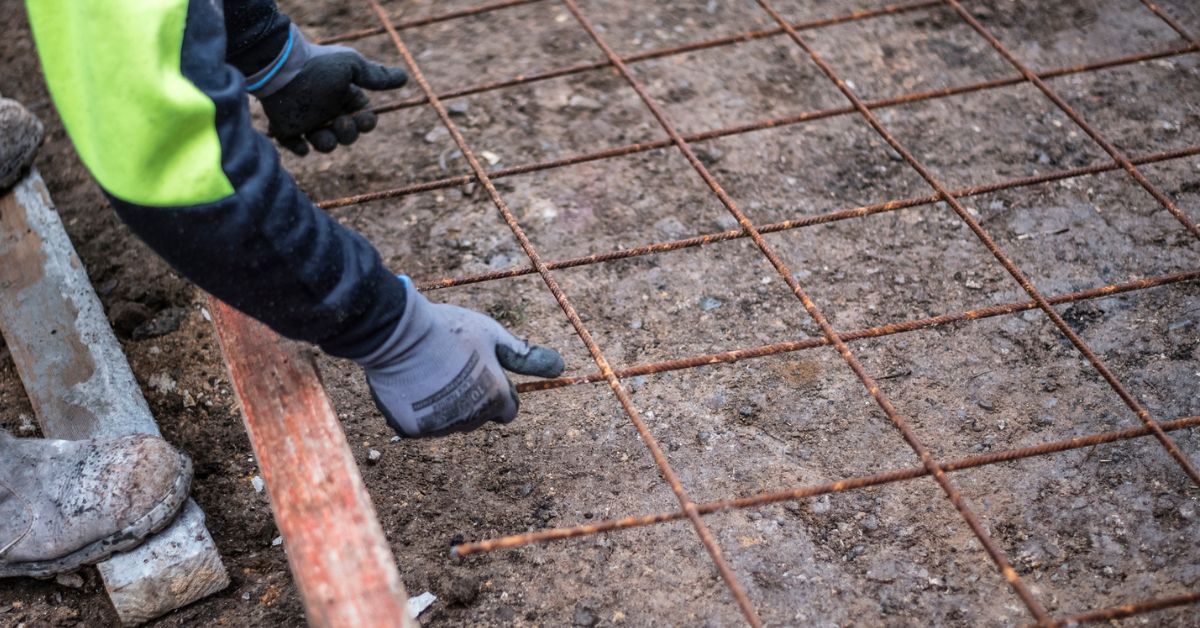
Rebar means laying down a grid of heavy steel bars with ridges on them, which help them grip the concrete. Unlike wire mesh or fiber, rebar is genuine structural reinforcement — the same tool used in house foundations and retaining walls. On a court, it gives you meaningfully more resistance to cracking from ground movement, without the cost or specialized crew that post-tension requires. If your soil shifts more than average and you want a real step up without going all the way to post-tension, rebar is a nice middle ground.
Post-Tension: The Best in the Business, When It's Available
Post-tension concrete is the best foundation option there is for a pickleball court. Steel cables run through the slab and get tensioned with hydraulic jacks after the concrete cures, putting the entire slab under permanent compression so it moves with the soil instead of fighting it. That allows you to pour one uniform slab with no expansion joints — the intentional cuts made in less-reinforced concrete to give it room to move — so you end up with a single, smooth playing surface. Post-tension is the most likely of all the options to hold up over time, with some courts showing no evidence of cracking even 5 years after the initial pour.
The honest caveat is availability: post-tension requires a specialized crew and materials that not every region has easy access to, and it typically costs meaningfully more than the other options. Where it's available and your budget supports it, it's the right call.
Cost Differences
An asphalt pickleball court is the least expensive option across the board. Wire mesh and fiber run close to each other, both meaningfully cheaper than rebar, since rebar adds both material cost and the labor of placing a grid correctly. Post-tension sits at the top by a real margin — it requires specialized cable systems and a crew trained specifically to install them, and that combination drives the price, not the concrete itself.
Durability
Post-tension holds up the longest with the least cracking, by a real margin. Rebar is a genuine step up over wire mesh and fiber for resisting ground-movement cracking, though not in the same league as post-tension. Wire mesh and fiber both hold up well against ordinary shrinkage cracking but tend to need resurfacing sooner than rebar or post-tension when the ground itself is actively moving. Asphalt is the outlier: it's typically the first to show hairline fractures in stable, warm climates, but in a real freeze-thaw climate, its flexibility can actually outperform a rigid, unreinforced concrete slab — durability here depends on climate as much as material.
Does Foundation Affect Playability?
Not much. Your actual experience on the court comes down to the court's dimensions and the surface material you choose on top, acrylic or cushioned, more than which foundation is underneath it. Foundation is really about long-term durability and cost, not how the court feels to play on day one.
Every court and every property is a little different, which is why we walk through this with you directly rather than pushing one answer for everyone.
Plan Your Foundation the Right Way
Foundation decisions set the stage for everything else about your court. Our backyard courts page covers the full build process, our Construction hub walks through construction more broadly, and our surfaces guide covers what goes on top of your foundation once it's poured. If you want to see how foundation choice factors into your total budget, our pickleball court cost guide breaks that down too. And whatever foundation you choose, keeping it crack-free long-term comes down to upkeep — our guide to maintaining a pickleball court covers what to watch for and when it's time to resurface.
Ready to get your foundation right the first time? Book a free consult and we'll walk through what makes sense for your soil, your climate, and your budget.
Ready to Build Your Court?
Book a free 15-minute call with Alex and get expert insight specific to your yard and goals.
Book Free Consult