Pickleball Court Lighting: How to Light a Court for Night Play
Lighting is one of the most important, and least understood, parts of building a pickleball court. If you want to play in the evening, they are an essential choice.
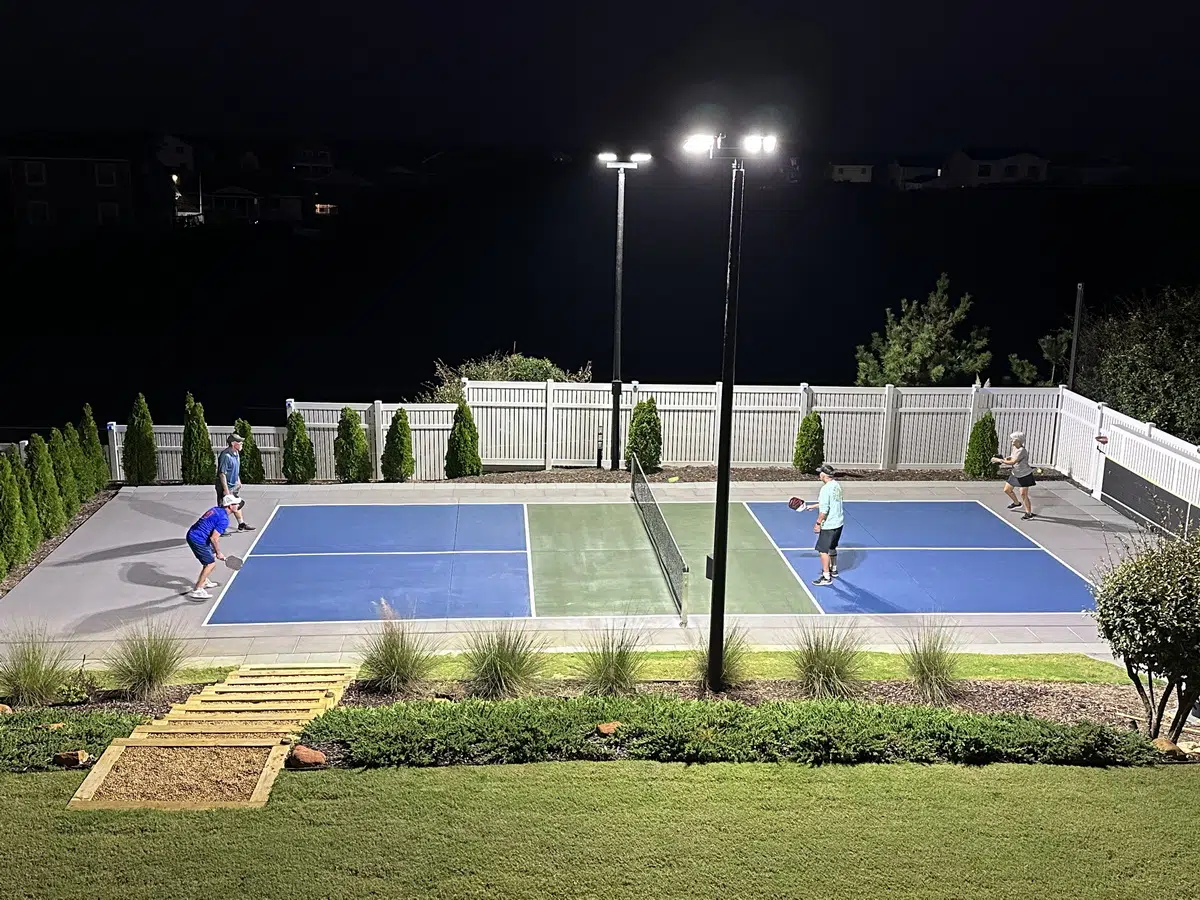
When a prospective court owner ask the question, "do I need lights?", it opens up a lot of questions. Installing lights that do their job properly at night without breaking the bank or overdoing it and creating worse blind spots is complicated. We work through all of it with you, combining player experience with builders who've installed plenty of these systems.
How Pickleball Court Lighting Works
A few things go into a lighting setup:
- how many poles per court
- how many fixtures on each pole (up to four)
- what type of light you use
- where the poles sit and how tall they are
- how everything connects back to your power supply
Here's how we typically approach each of those.
How Much Lighting Do You Need?
For a single backyard court, the ideal setup is two poles, one on each side along the net. Some homeowners can get away with one pole carrying two fixtures, angled to face each side of the court. Which setup makes sense depends on your climate, how dark it actually gets when you want to play, your yard's layout, any shadows or obstructions nearby, and how much light you personally want on the court.
What Type of Light Should You Use?
LED is pretty much universally agreed to be the best in class for sports lighting. Compared to metal halide or halogen fixtures, LED lights are more durable, more energy efficient, and lower maintenance over time. They also cost less to run. We recommend LED on every build.
Color Temperature
For backyard courts, a color temperature around 4,000K is preferred, warm enough to feel comfortable for home use. Commercial and public installations tend to go with something closer to 5,000K, a crisper, more daylight-like quality that suits higher-traffic or indoor settings.
Pole Height
Twenty feet is the standard recommendation for the best coverage and the fewest shadows. Some local ordinances cap pole height lower than that, and we can work within whatever your area requires.
Placement and Power
Where your poles can go depends on your yard, specifically where your power source is, how far the court sits from it, and anything else near the court that might get in the way. This is very site-specific, which is part of why we walk it with you rather than guessing from a distance.
We complete the bulk of the project turnkey, but we always recommend bringing in an electrician for the actual lighting connection. We handle the poles and the install, the electrician handles tying it into your power.
What Actually Matters When You're Playing
As a player, what I care about is simple: no shadows, even coverage across the whole court, and no spot where you're looking up into a light mid-rally. Sometimes I actually recommend building your court first without lights. That way you can see exactly where the dark spots are, how much evening play you're really getting, and what you actually need before you spend money on a lighting package.
Talk to Us About Lighting
Lighting is easiest to plan as part of your build, but it can also be added later. Our backyard courts page covers the full process, and if you're weighing lighting as part of a resurfacing project, our resurfacing page covers retrofits.
Have questions about lighting for your court? Book a free consult and we'll walk through what makes sense for your space.
Ready to Build Your Court?
Book a free 15-minute call with Alex and get expert insight specific to your yard and goals.
Book Free Consult